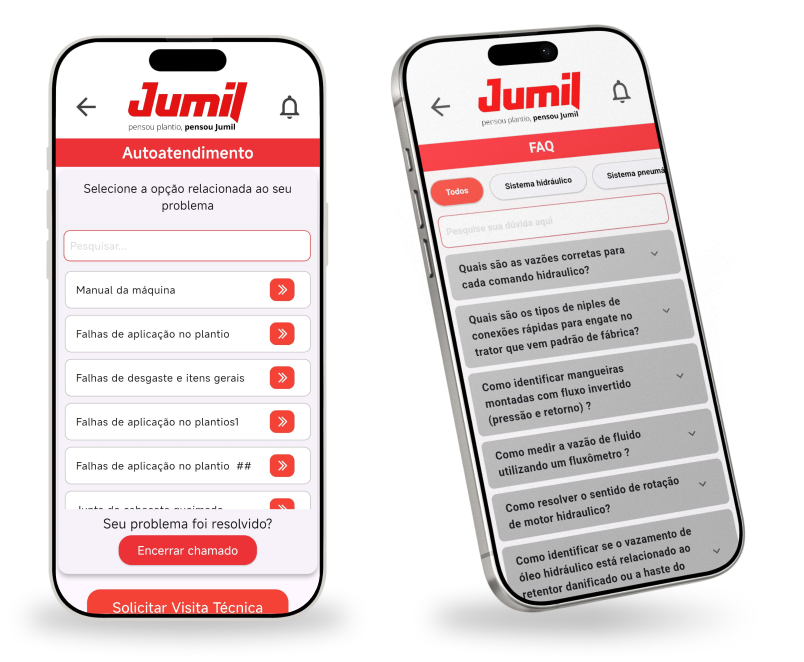

Whenever you need service or replacement parts, please contact one of our authorized dealers or service providers. We are ready to assist you with a trained and experienced team.
Click the link below, enter your ZIP code, and the system will provide information about the nearest Jumil partners:
Yes, we offer the following training programs:
JM SERVICES PHONE: +55 16 3660 – 1015
To find the nearest dealers, simply visit the link below and fill in the city and state fields. The platform will provide a list of the nearest dealers.
In addition to courses for machine operators, we conduct on-site training at our Jumil factory throughout the year, as well as regional training sessions according to our annual schedule. We also make the Jumil distance learning platform available to our authorized dealers and service providers. Please contact us to request access.
Yes, visit our online store at:
Yes, please contact our team directly for any inquiries at the following phone numbers:
+55 16 3660 – 1031 | +55 16 3660 – 1018
We have several types of motors and hydraulic controls that require a direct flow supply from the tractor, which are:
1) TURBINE WITH HYDRAULIC MOTOR – required flow rate: 25–35 liters per minute;
2) POWER BOX – flow rate of 18 liters per minute.
3) LIFT SOLENOID BLOCK – at least 60 liters to 100 liters; if possible, connect it to the tractor’s priority control.
4) FERTILIZER AND SEED HYDRAULIC MOTOR – flow rate of 60 liters per minute.
The connection nipples are supplied according to the tractor’s make and model. The options may include:
NIPPLE 1 – MALE PRESSURE CONNECTOR (LIFT, TURBOCHARGER, ENGINES, POWER BOX, 1/2" SOLENOIDS).
NIPPLE 2 – FEMALE CONNECTOR (1-INCH PRESSURE RETURN).
NIPPLE 3 – MALE CONNECTOR (1/2-INCH MACHINE DRAIN).
First, you’ll need to identify the direction of rotation of the hydraulic motor. If it isn’t marked on the part, it will always be from the larger-diameter connection to the smaller one. Once identified, follow the hoses to the connection; the pressure should enter the larger-diameter connection—that is, in the direction of the motor’s rotation.
First, connect the flowmeter hoses to the points to be measured. Next, install the pressure sensors and magnetic flow sensors, connect the cables to the analyzer, and take readings during a simulated operation.
You cannot change the direction of rotation of a hydraulic motor by reversing the hoses; instead, you must turn the directional valve. Turn the valve 90 degrees, and the direction of rotation will change.
Once you have confirmed a hydraulic oil leak at the seal/rod junction, check the condition of the rod. It must be perfectly smooth, with no damage or blemishes on the chrome plating, and straight, to ensure a proper seal.
A check valve—also known as a non-return valve or one-way valve—is a component designed to allow fluid to flow in only one direction, thereby protecting the system by preventing the liquid from flowing back upstream of the valve.
Pay close attention to the measurements and recommendations regarding thread type, pitch, and materials as described in your tractor’s manual. Always use thread sealant, taking care to ensure the required tightening torque and avoid damaging the parts.
When changing the tractor’s oil, always follow the manufacturer’s recommendations; however, some signs that it’s time to change the oil include:
– The oil is muddy, darkened, and dirty;
– The presence of residue in the reservoir;
– Foaming in the oil (indicating contamination with air);
– A milky appearance (indicating water contamination).
The standard Jumil compressor has a manual regulator on the left side. To open the airflow, turn the regulator clockwise to set the desired pressure between 1 and 4 BAR.
The ideal pressure for planting in sandy soil is 1.5 BAR; for stiffer soils, this value can range from 2.5 to 4 BAR. It is important to always perform a functional test by measuring the quality of the soil mixture produced by the planter, without using the seed cover.
A turbine with a Jumil hydraulic motor is capable of powering:
– Conventional turbine – up to 17 lines per unit.
– Invicta turbine – up to 20 lines per unit.
The ideal working flow rate ranges from 50 to 60 millibars, depending on the seed conditions.
Leaks and damage to connections will cause the system to lose pressure. It is normal for the compressor to cycle 3 to 4 times during a standard operation; if this occurs more frequently, it may be a sign of pressure loss due to leaks.
The proper operation of the distributor depends on a good vacuum, so always check the condition of the rubber seals, the connections at the nozzles, and for any leaks or pressure drops in the systems. Cleaning and preventive maintenance of these components are essential for successful planting.
Check the condition of the pneumatic hose couplings, inspect the integrity of the rubber air boots on the pneumatic springs, and always drain the water from the air compressor filter.
By preventing pressure loss due to air leaks in the system, always draining the condensed water from the compressor filter, and ensuring that all components and connections are in good condition.
Yes, it requires a 12-volt power supply.
The pneumatic system will not significantly increase your tractor's diesel fuel consumption.
Whenever there is a communication failure between the modules and the display, it may be a sign that a fuse has blown.
By conducting a thorough inspection of the cable, testing for continuity in the sections of interest, and narrowing down the section until the exact point of failure is identified.
The standard sensors approved by Jumil are: DICKEY JHON SENSOR, SAFRA MAX SENSOR, PRO SOLUX SENSOR, and WAVE VISION SENSOR.
Intermittent or continuous malfunctions may be caused by broken or loose connections. Whenever your equipment experiences malfunctions in the seed lines, fertilizer or seed motors, lift sensor, or GPS antenna, check the connections and perform a functional test.
The following is required:
1) 12 Volts for: EASYTECH, PM400, MP36, BOSCH, PRECISION PLATING, J’ASSY, and EASYTECH ELETRIC systems.
2) 24 volts for: BOSCH and EASYTECH ELETRIC motors.
If the display does not detect the seed sensor or if it is measuring incorrectly, this may indicate a total or partial blockage, or even that the sensor has burned out. Perform a visual inspection inside the seed tube using adequate lighting.
Go to your system settings, and you'll find an icon that shows your operating system version.
Go to your system settings, and you'll find an icon that shows your operating system version.
Contact an authorized technician and request a software update whenever necessary.
Signs that your system may have a short circuit include: frequent blown fuses, overheating of electrical cables, or relays tripping.
DISPLAY – FULL CONTROL OF THE MACHINE. MODULES – CONTROL OF SEED SENSOR, LIFT, SOLENOIDS, ENCODER, GPS ANTENNA. ENCODER – RPM AND CONTROL OF HYDRAULIC MOTORS


1) Number of rows (example: 9 rows)
2) Add 1 to the previous value: 9 + 1 = 10
3) Multiply by the spacing (example: 0.50 cm) – 10 × 50 cm = 500 cm or 5 m
4) Measure the front track width of the tractor (center to center) (example: 1.86 m or 186 cm)
5) Calculate the difference between the value from step 3 and the value from step 4, i.e., 5 m – 1.86 m = 3.14 m
6) Divide the value from step 5 by 2, e.g., 3.14 ÷ 2 = 1.57 m
The value of 1.57 m will be used for each side
DOUBLE DISC 10 TO 12CV PER ROW
FURROWING MACHINE 12 TO 15CV PER ROW
SUGAR CANE FURROWING MACHINE 20 TO 25CV PER ROW
The recommended amount is 3 to 5 grams of graphite per kilogram of seed.


 Download on App Store
 Download on Google Play